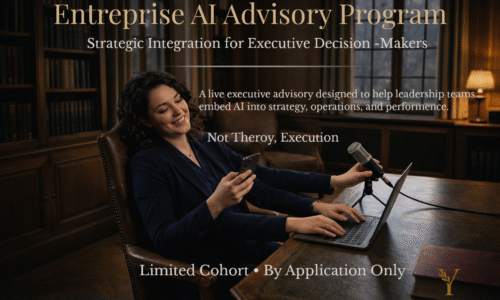
The AI training program for executives is a live workshop designed to be practical, actionable, and directly relevant to your organization.
It is built for executives, professionals, and teams who want to move beyond theory and use AI as a real performance lever in their day-to-day operations.
You are guided step by step, with a clear and structured approach.
Each session is tailored to your reality: your industry, your challenges, your level, and your real use cases.
This program is based on a fully independent perspective:
the goal is not to promote any specific tool or platform, but to give you a clear and objective understanding so you can make the right decisions for your context.
You will learn how to understand how modern AI works in simple terms, and more importantly, how to use it to:
- Automate workflows and processes
- Improve decision-making
- Increase team productivity
The workshop combines clear explanations, guided exercises, workflow design, and practical methods to manage AI limitations such as bias, inconsistencies, and hallucinations.
Every concept is directly connected to measurable business outcomes.
By the end of the training, you leave with a structured, repeatable framework that you can immediately apply within your organization.
Included:
- Full session recording (available for 3 months)
- A detailed practical guide to support your implementation
- A clear and independent methodology to integrate AI into your operations
This program is ideal for companies, consultants, trainers, teams, and professionals looking to quickly build high-impact, practical skills.
Reserve your spot today and turn AI into a real competitive advantage.
Features
- This program goes beyond prompt writing.
- You will understand how AI models actually work.
- You will learn how to structure AI usage around your strategic objectives.
- You will develop a clear framework to integrate AI into your daily workflows.
- You will transform AI from a simple tool into a performance driver.
- You will learn how to manage AI limitations such as bias, inconsistencies, and hallucinations.
- You will build a repeatable framework that can be applied within your organization.
Target audiences
- Business owners and founders seeking to integrate AI into their strategy and decision-making
- Executives, senior leaders, and board members
- Team leaders and managers responsible for performance and innovation
- Consultants, trainers, and professionals who want to structure their use of AI
- Anyone curious about AI or already using it daily and looking to turn it into a strategic advantage
Requirements
- Ability to read, write, and understand professional-level material
- An active subscription or free account on a commercial AI platform
- Intellectual curiosity and openness to innovation
- Willingness to experiment and apply AI in a professional context
Curriculum
- 9 Sections
- 32 Lessons
- 4 Hours
- Welcome & SetupWelcome messageCourse objectivesQuick participant survey: – Profession / domain – AI experience level – Why they’re taking this courseSession logistics & format3
- Understanding AI: Essential FoundationsTheoryWhat is AI?Differences between rule-based AI, statistical AI, and LLMsThe computer as an “ultra-fast calculator”What AI is NOT: limits & mythsQuick Exercise (5 min)Mini interactive quiz: “Can AI do this?”5
- Natural Language & How LLMs WorkWhat is natural language?How a LLM “understands” textTokens, embeddings, patternsStrengths: synthesis, generalizationWeaknesses: hallucinations, bias, contradictions6
- First Steps: Creating Your First PromptTheoryMinimal structure of an effective promptThe importance of contextClarity first: who, what, how, why4
- Method: What a LLM Needs To Work Well (25 min) TheoryThe model needs: role, purpose, constraints, format, contextHow to frame the model without overloading itPrinciple: say less, but say it betterExercise (5 min)Turn a weak prompt into a strong one (before/after)4
- Optimization: Improving Quality Without ComplexityWhen to add instructionsHow to correct the modelAnti-hallucination strategiesHow to structure a multi-step request6
- Working With Minimal InstructionsA. Discovering an Unknown Topic (Identifying what is known, unknown, and needs clarification)B. Exploring Multiple Solution Paths (Generating and comparing alternative reasoning strategies)C. Avoiding Errors and Hallucinations (Diagnosing risks, exposing assumptions, controlling reasoning)D. Structuring Knowledge and Organizing Information (Decomposition, hierarchy, and logical reconstruction)E. Rapid and Effective Synthesis (Compression → controlled expansion → professional formats)5
- Personalized Real-World CasesSuit the professions of the participants (examples):writing tasksanalysissynthesisevaluationidea generationinformation extraction1
- Wrap-Up & ResourcesSummary of the methodCommon mistakes to avoidGood general practicesOverview of included PDF and materialsQ&A5
FAQs
Instructor